2023
Banski dvor, Banjaluka
If we ask the question what is the difference between memory and memories (recollection), the answer is that memory is focused on a factual, confirmed the actual, while the recollection is an extremely individual act of data storage, which leads us to the conclusion that memory is focused on information about a subject or about something actual, while recollection is also directed towards that deceptive element that could be, but is not necessarily conditioned or given. It is precisely on this postulate that recollection anticipates psychological processes, emotional states and events, that it records them, for the history of the irrelevant flickering of the soul, the artistic vision of the so-called "objective reality", that is, the artistic postulate of explaining historical flows and events as well as personal, emotional, cognitive, perceptive and epistemological states, events and processes.
Therefore, it is much more important for the artist to illuminate the events from the point of view of recollection, evocation, reminiscence and/or the unrealized, desired, dreamed, imaginary aspect of understanding the historically confirmed course of events. Even in ancient times, a clear opposition between memory and recollection was expressed.
Thus, the famous poet Simonides of Keos, having received the task of singing the victories of the famous boxer Skopas, expressed more praise to the gods than to the fighter himself, which is why he received only a third of the expected fee, but, in gratitude for the praises given, the gods saved him from certain death in Skopas's house, which suddenly collapsed. Skopas and his friends died in the ruins. According to the exact, factual memory of Simonides, the seating arrangement was reconstructed and thus all of them could be buried under their 2 names. So, even then, the artist's memory helped to reconstruct an immediate historical event. However, the situation with the artist's recollection is completely different, because it is directed towards reminiscence and association with: events, persons, circumstances and experiences and as such, is, to the greatest extent possible, directed towards emotional content.
Hence the artist's demand for empathy in his work, that is, for a complete anticipation of the intended world. This process is characteristic of the most important artists and their works, while the process of sympathy, empathy, with the content of the work, and especially with the figures and characters given and presented in its primary form (portrait, bust, sculpture, etc.) is more related to the works of weaker artistic intensity, and a greater and wider scope of acceptance by the widest audience. This is precisely why the requirements of reception and perception of the aesthetic level and content of the work are separate for the widest audience and those belonging to narrower professional circles.
Marina Nićiforović's developed, meaningful and well-thought-out artistic concept: "Forms as a refuge of memories” insists on remembering as the basic, primary postulate of the interaction between the recipient and the creator of that and such an artistic sign. The very essence of her observation of space is represented by reminiscence (reminder, recall) the most emotionally filled field of intimate landscapes, the backbone of which we find in the interpretations of the meaning of the doorstep symbol. Nićiforović very skilfully translates the noun phrase: "household doorstep" into an imperative against the background of visual expression: "Protect! Nurture! Develop!" ancestral tradition because for her the doorstep is not only the place where the ancient Antis stored the skulls of the sleeping fathers, but a refuge, a place from which she sees the night sky surrounded by stars, when it seems that they can be plucked by hand.
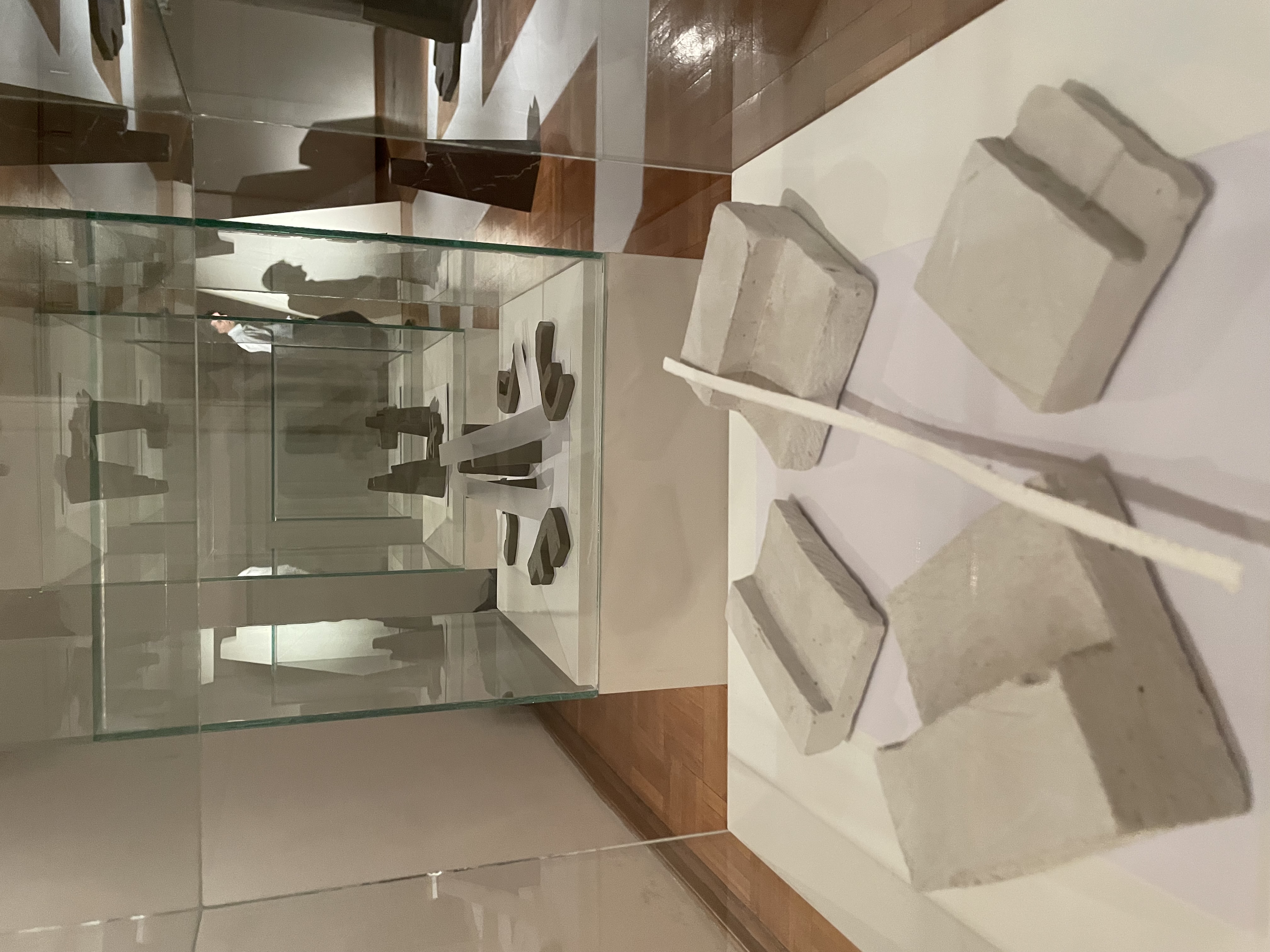
From that meeting of the girl's gaze and the cosmos, the objectification of the 3 doorstep of vision arises, because that is the place from which she sees: : Gradina, St.Peter's Church and St. George’s Church. Hence the unity of sound (wind noise), space (stone objects) and light. Her drawings, sketches, preparatory works in clay reveal the complex structure of this synergistically modulated and postulated artistic expression. Moving within the given and defined parameters: experience, memories and memory, Marina Nićiforović strives to unite all these divergent forces in her spatial artistic sign and to establish a unique semantic flow that connotes a complex structure based on classical, ancient, heritage as well as contemporary, a completely modern approach to the materialization of a spatial sign as a separate symbol both in and for itself. With the fact that, in this current search, in the domains of spatial fine art, Nićiforović opts for the extremely specific role of the spatial sign as an object of artistic observation. All the more so because in this way he achieves the unification of architecture and sculpture, because in the sculptural expression he embodies both emotional and all other connoted contents.
From all this, a complex structure arises, in which the epicentral element is the material - stone, which with its planar segmentation (ratio of robust and smooth surfaces) is integrated by geometrization, only in this way would it become a unique spatial sign with full meaning. A careful observation of this and that form reveals its deep emotional traces. The artist's individual memory, when as a barefoot girl she first touched that unusual stone from Stara Raška, met with a series of collective memories already at its primary origin. Gradina, a picnic area, until recently disorganized and neglected, is today a very important archaeological site, because its formation bears witness to an ancient, large city built in the Byzantine style.
The source of the medieval Serbian state of the great prefect of Nemanja, is the first childish sensation in the tactile world of the artist, while from the same place the outlines of, 4 then abandoned St.George church and the oldest Orthodox church in the Balkans, the church of the Holly Apostles Peter and Paul, catch the eyes. Wherever she turns from that place, the girl, and later the artist, records in her primary memories the origins and hubs of civilizations with a refined sense of space. On the one side, it is the basis of Nemanjic Serbia, and on the other, Byzantine and Islamic tradition and culture. The Old Ras stone thus becomes an object of artistic observation, because its memory touches all these elements of collective memory, and only under the influence of individual memory with deep emotional layers does it become the subject of artistic observation in which all these elements are indicated and given.
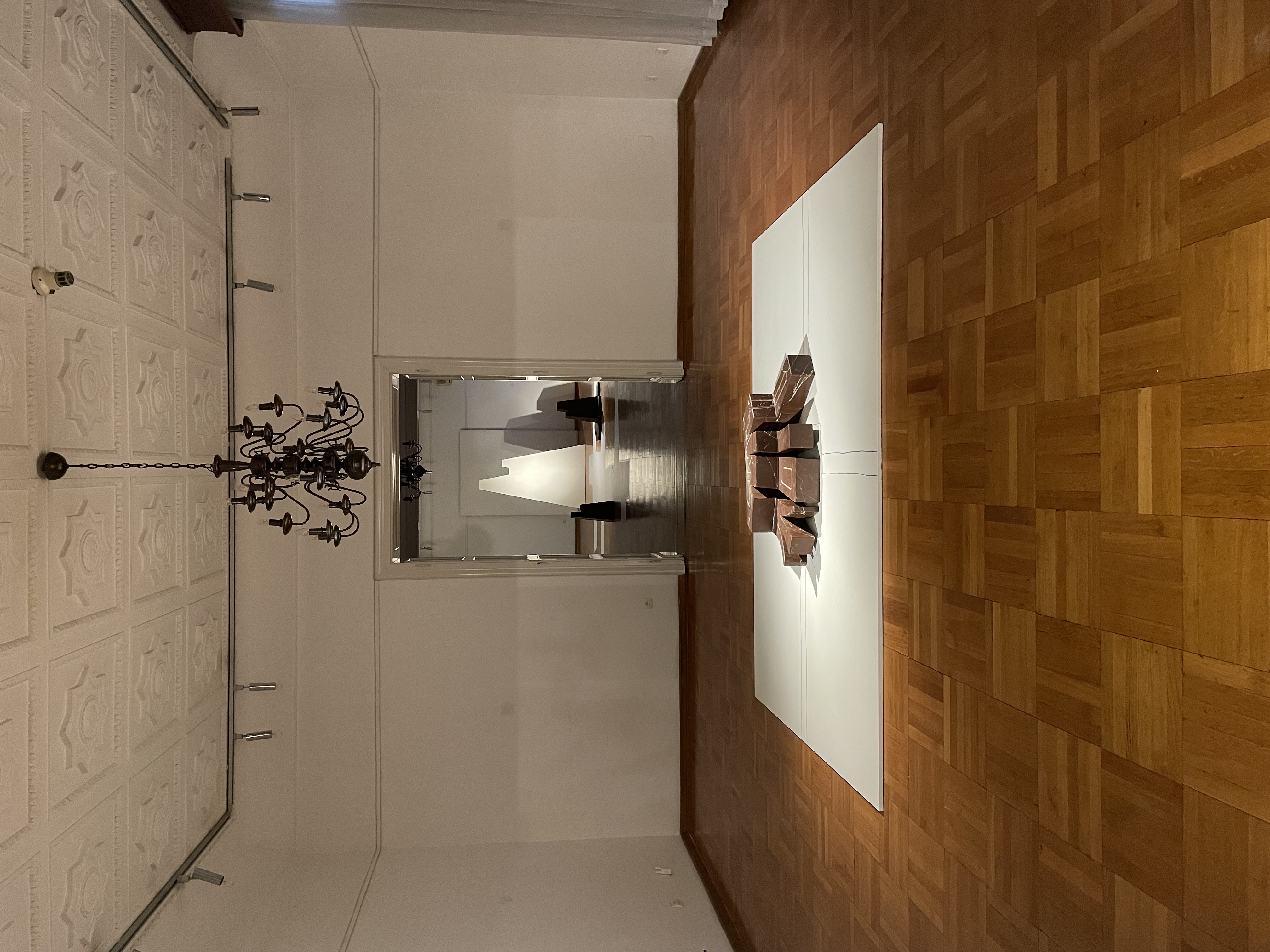
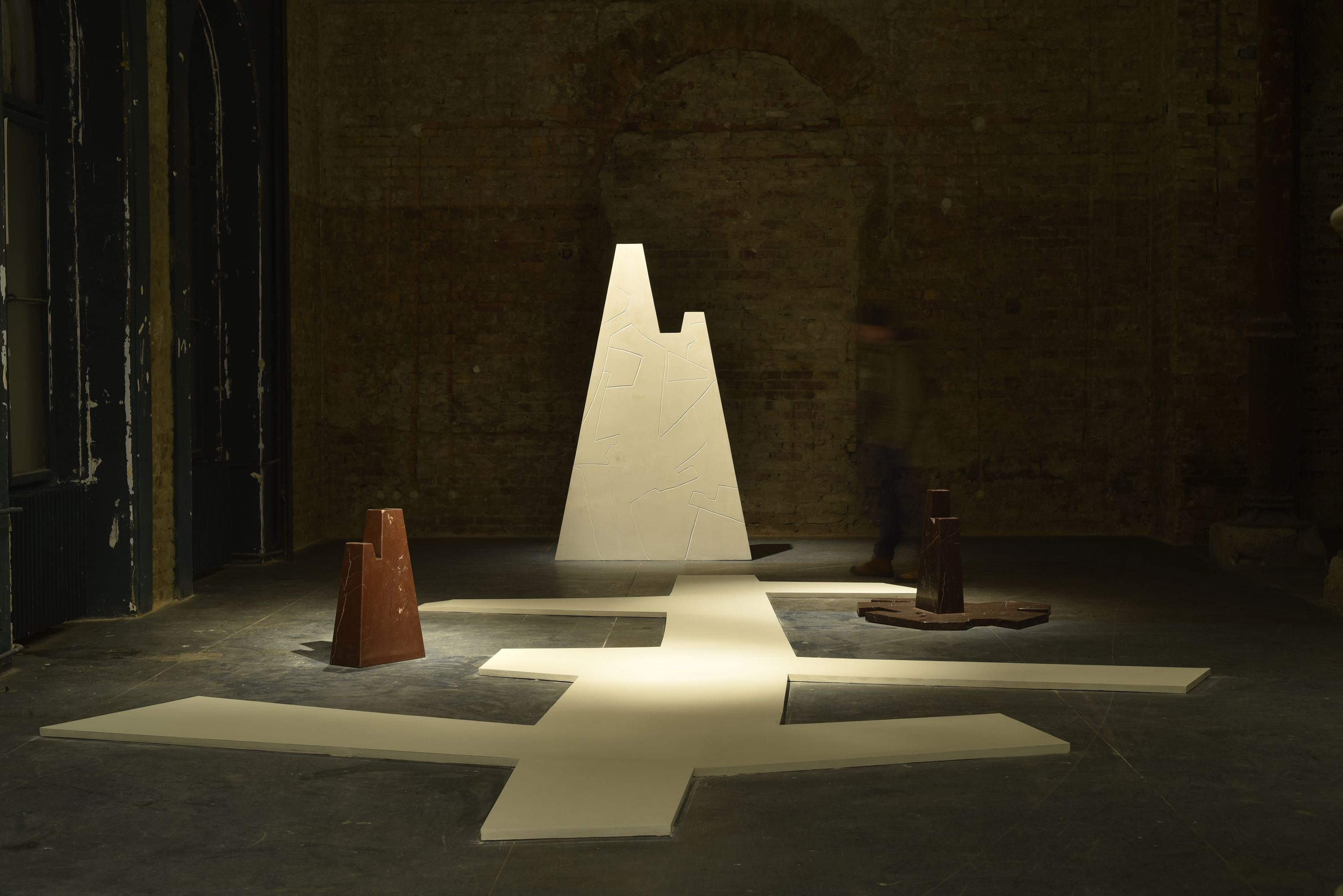
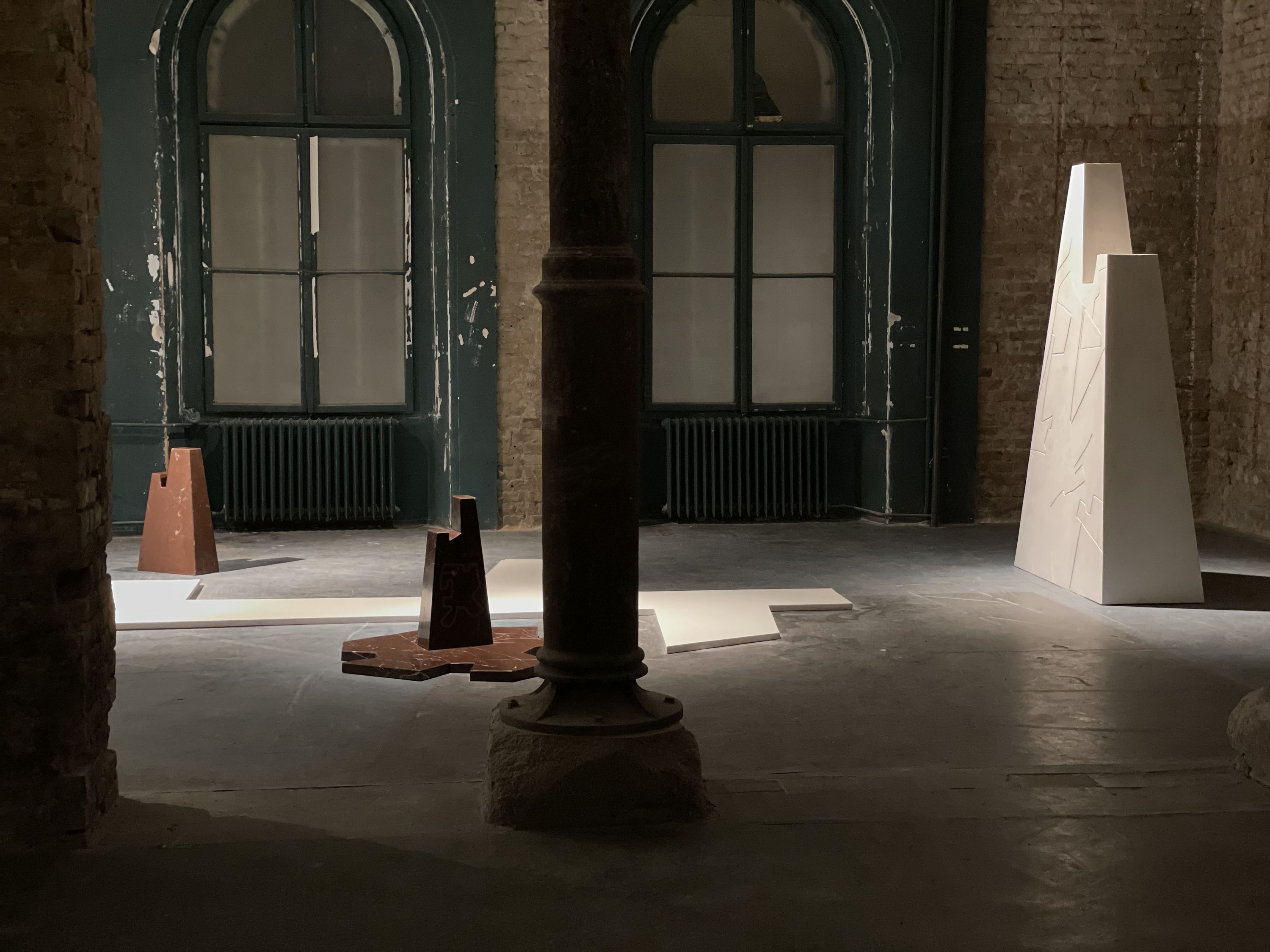
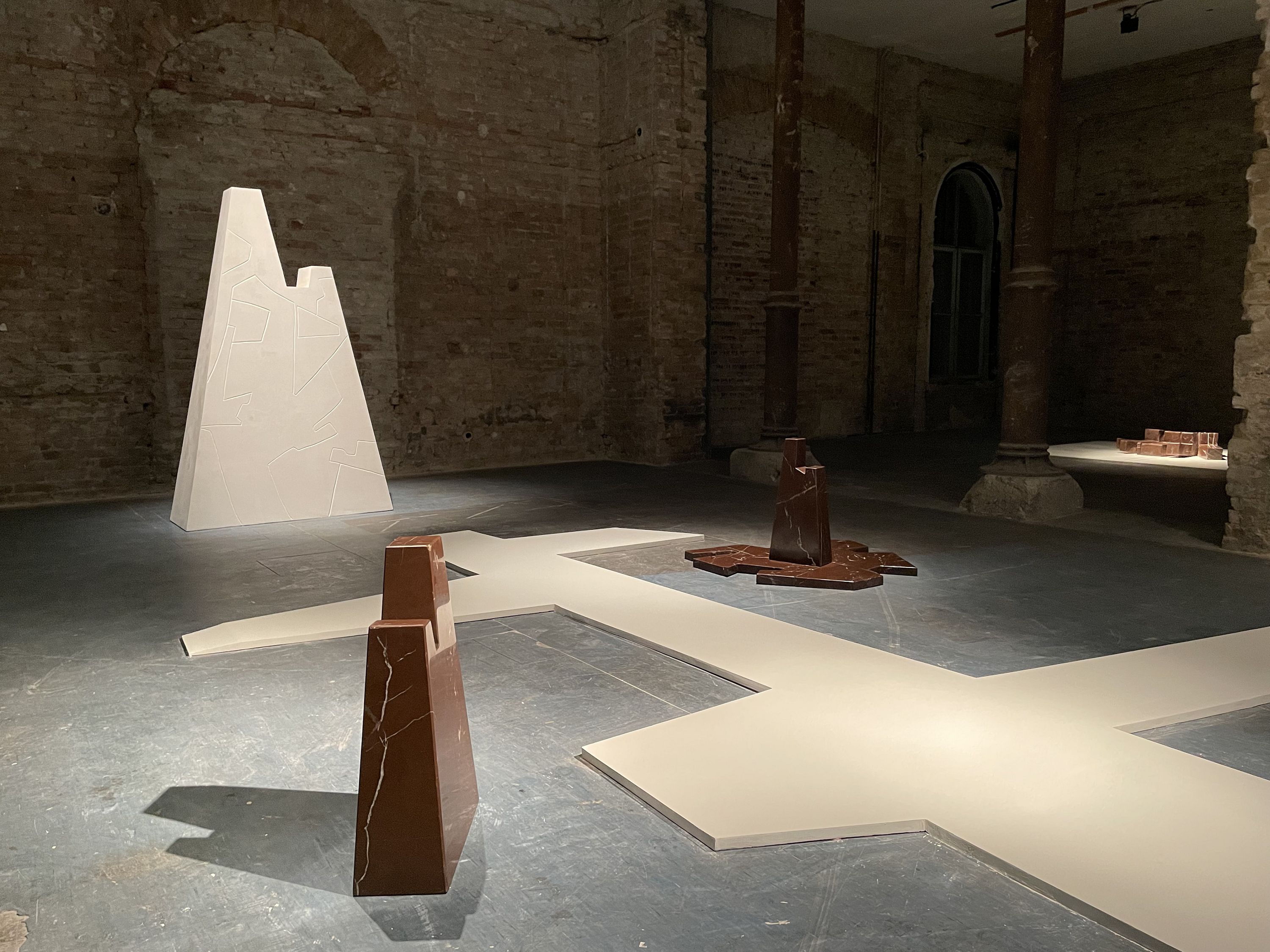
The Stone City (Gradina), St. Peter's Church, Pazarište (the Old Ras), St. George pillars, Sopoćani Monastery, The Fortress (Jeni - Pazar / Novi Pazar) and Lejlek Mosque in the vision of Marina Nićiforović is transformed into: association, recollection, memory, remembrance, search, discovery, finding, invention, expectation, longing, in other words, duration in the energon of total human existence. The gentle, lyrical line, softened almost to a watercolor stroke, is reminiscent of Phidias and the 5th century BC. and Niobidus in fatigue, only there is no figure here, nor a female nude, but the pathos that appeared then for the first time is there. The relief of weighted whiteness are additional accents of such and that pathos. The polishedness of the white and colored stone, it is very important to emphasize here that it is not an artificially colored stone, allows them to be equipped as a kind of mirrors in which each of the observers can find or discover some part of their memory or recollection. The floor plan of Gradina, bounded by three reference points, clearly suggests the way in which architecture was translated into sculpture.
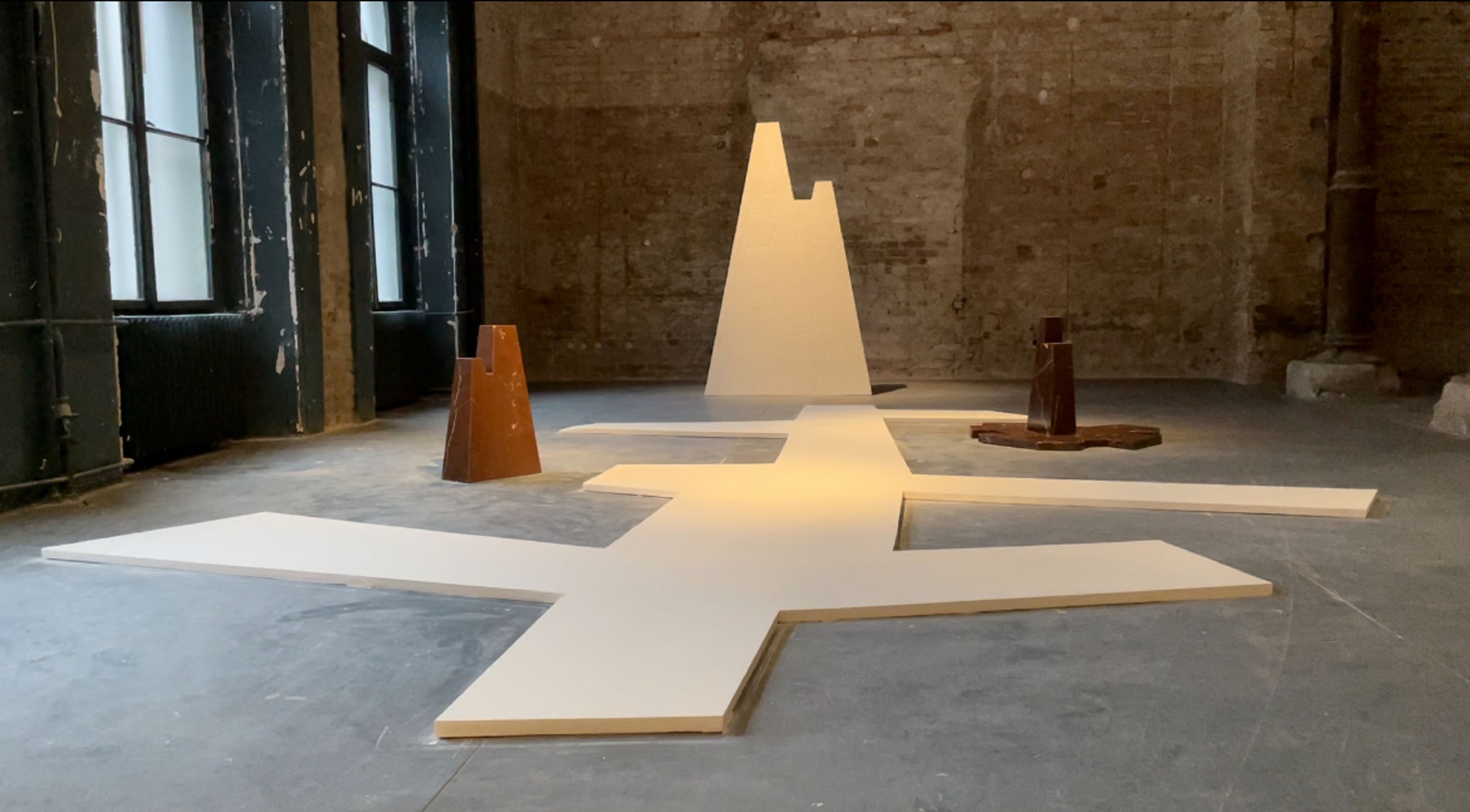
5 It is precisely on the basis of such a complete spatial sign that we can engage in the game of discovering the meaning of structures and their artistic content. The relief, and that indented, allows this solid plastic to be experienced as a kind of trace in time and space. The diverse path can also be determined as a game of heaven and earth (the so-called "play school") with the fact that the "stones of the game" are in the sketches in the showcases. If we start from the blueprint, then through to the model and finally if we come to the object, we will notice that at the root of the "white path" is not only the ground plan of the Gradina, but how it is transformed into the crossroads of the Raška river that flows under the Gradina, irrigating the fertile soil of the place of Marina's upbringing. Movement along these backwaters or intersections is a basic feature of all places where cultural, civilizational and historical hubs of different religions, peoples and countries meet. There, often, individual memories intertwine with collective memory - history, so that from that conglomeration or jumble of differences, the fruit of individualized, extremely emotional telling about oneself and one's own would emerge. Anticipating these civilizational hubs as his primary origin, Nićiforović offers us a truly powerful and impressive artistic review of historical and intimate memory as permeating duration. Cities, fortresses, whether they are described in Kronin, Exupéry and (or) Selimovic manner, remain as traces of reading in the memory, while in the artistic eye of Marina Nićiforović, they are transformed into true havens of the most subtle emotions, which are additionally stimulated by the very carefully thought out play of light on the object. By cutting, carving, with very skillful and very difficult steps of artistic shaping, Nićiforović manages to refute the claim that stone is not a material for a woman, but that a 6 woman is a material for stone, and in this way to establish a new domain in the history of Serbian sculpture, and it is "a woman's writing in stone".
After Vukosava - Vuka Velimirović, the first Serbian sculptor, and her works from the predominantly Parisian period, in the work of Marina Nićiforović, we once again get that significant "female script" in sculpture, all the more so since Nićiforović's work, in a contemporary, modern, but well-founded way on classicism, returns to great historical themes, which are not a tribute to personalities (Velimirović), but to landscapes - plein airs. Therefore, Marina Nićiforović can be called an inventive artist who translates the three-dimensional component of sculpture into three functions of space as an artistic element: plein air (landscape), architecture and full plastic. That is why her forms are and can be true refuges of memories, but also a place where some new individual and collective memories and remembrance will be found.
Aleksandar - Saša Grandić Phd




2021
Forms of modeling as a shelter of precious remembrance, Belgrade, Serbia
Personal remembrance in formation of artistic expression and significance of artistic education in formation of general cerative attitude
The outcome of Marina Nićiforović's doctoral artistic research, that treats the relationship between memory and form, is realized as a sculptural installation of a minimalist character. Although the original starting point is in intimate, personal memory, since that memory is founded on collective geolocations (surroundings of Novi Pazar: St.George’s pillars, "Gradina", Saint Peter’s Church, the Alley) and archetypes, it is of general importance. The installation is therefore an example of transposition of cultural heritage, externalizing and materializing historical remembrance into neo-modernist forms.
The central sculptural installation is a unique treatment of memory because it is not based on the direct representation of the subjective, but on its transformation into a completely new complex form. Like memories, that could be approached from a different angle each time, the installation does not follow linearity in the sense that it has the character of a puzzle open to new points of view and interpretations.
The part of the installation named "Doorstep" is inspired by the meeting place of intimate and collective cosmogony, at the same time again indicating transience but reminding of humbleness in prayer, as a way, at least temporarily, to touch the eternity. Particularly in this new and different materialization, of what would be transient, invisible and untouchable without the exhibited installations, lies the value of this endeavor.





2016
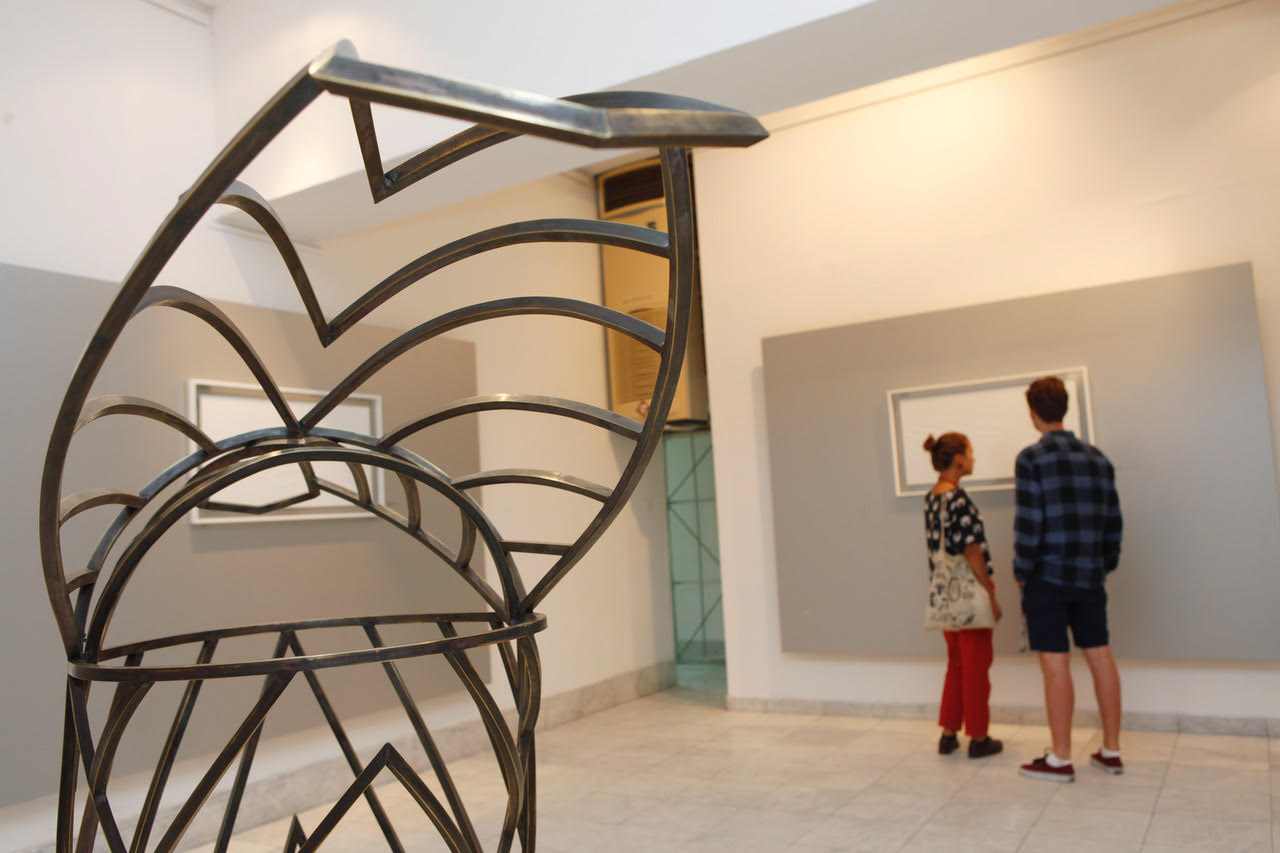
The More Winged Was Its Beginning, Belgrade, SerbiaDomination of purity of form raises a dilemma: is the reminiscence of the values of
clean forms an innocent way to talk one into self-sufficiency of experience of purity in the
displayed content or it is simply a step towards discovering spatial purposefulness? What is
pragmatic in this idea is the fact that the displayed content can be neither separated from the
idea that slowly grows in your mind, as the author informs us at the exhibition nor can it be
separated from the extended life of this strictly functional spatial realization.
Dragan Bulatović, PhD
(from exhibition catalog)
Of Other Spaces: Is This Me?
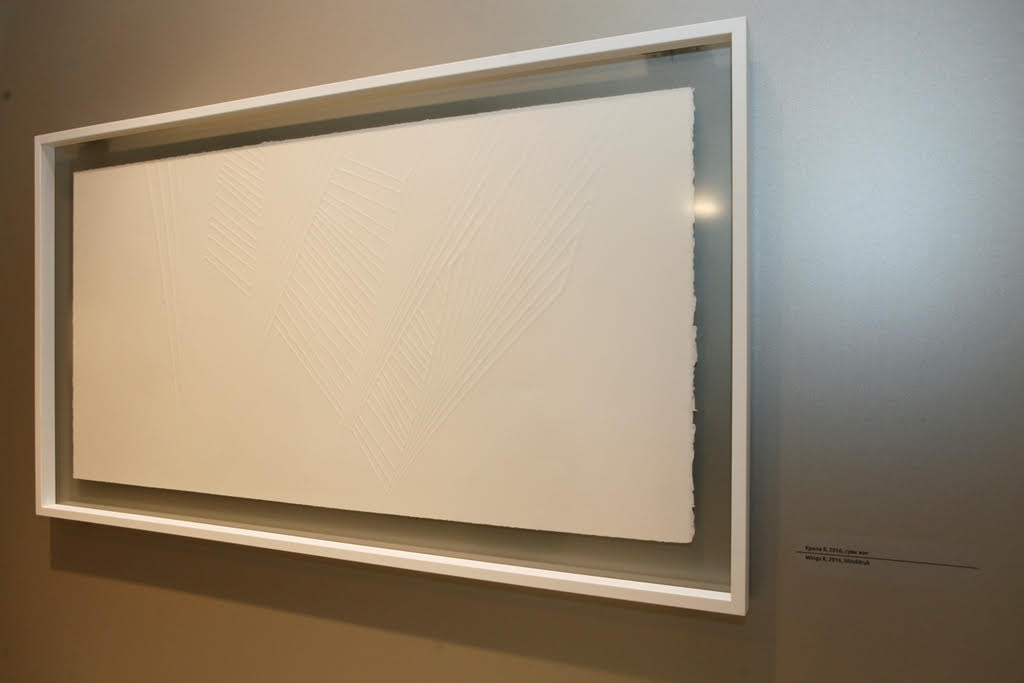
Formally, Marina Nićiforović’s graphic Wing 3 is an extension of the artist’s series of
sculptural works entitled The Beginning where she explores space and architecture, and
the visual link between the objects that she creates and their spatial position. In her
sculptural work, Marina does not want to interrupt the space; on the contrary, she wants
to merge her objects with the existing environment. Yet, in her visual images on paper,
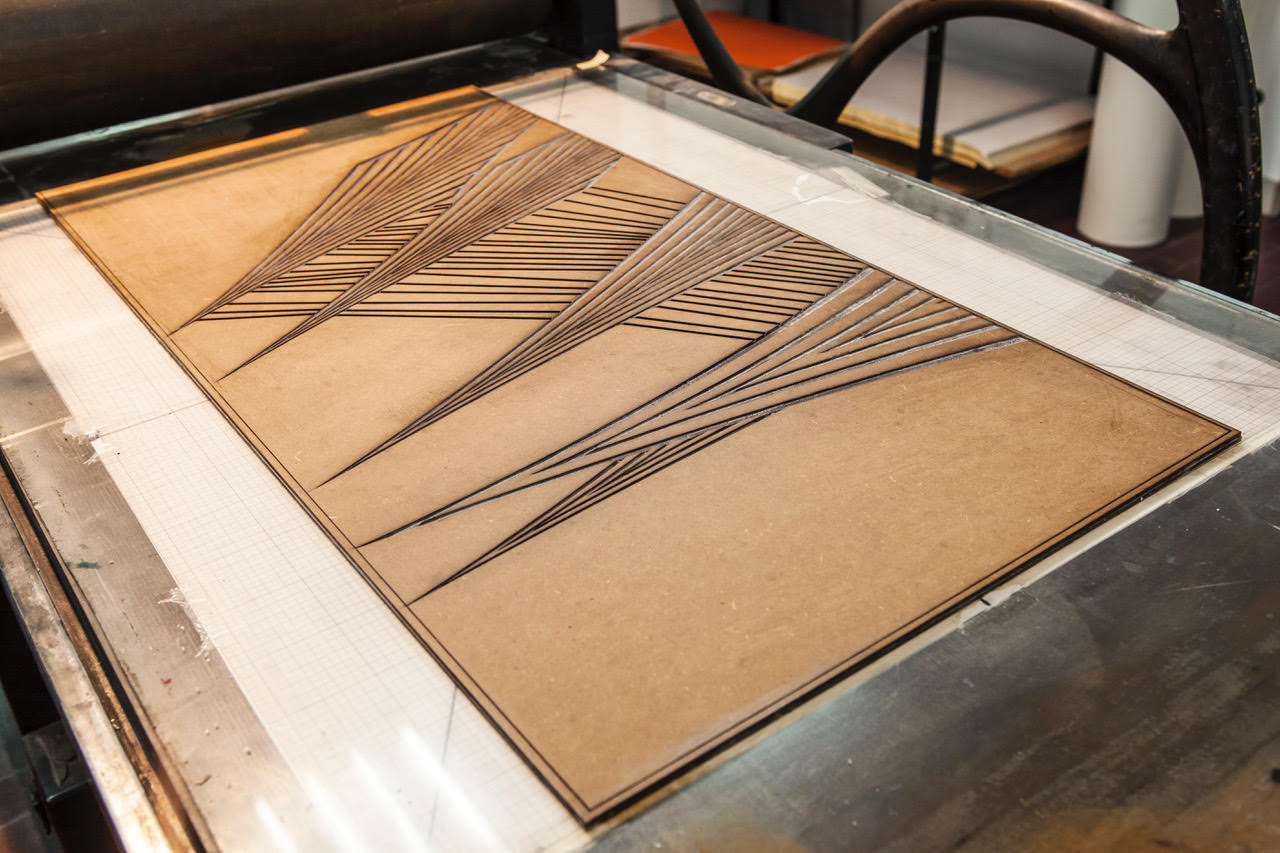
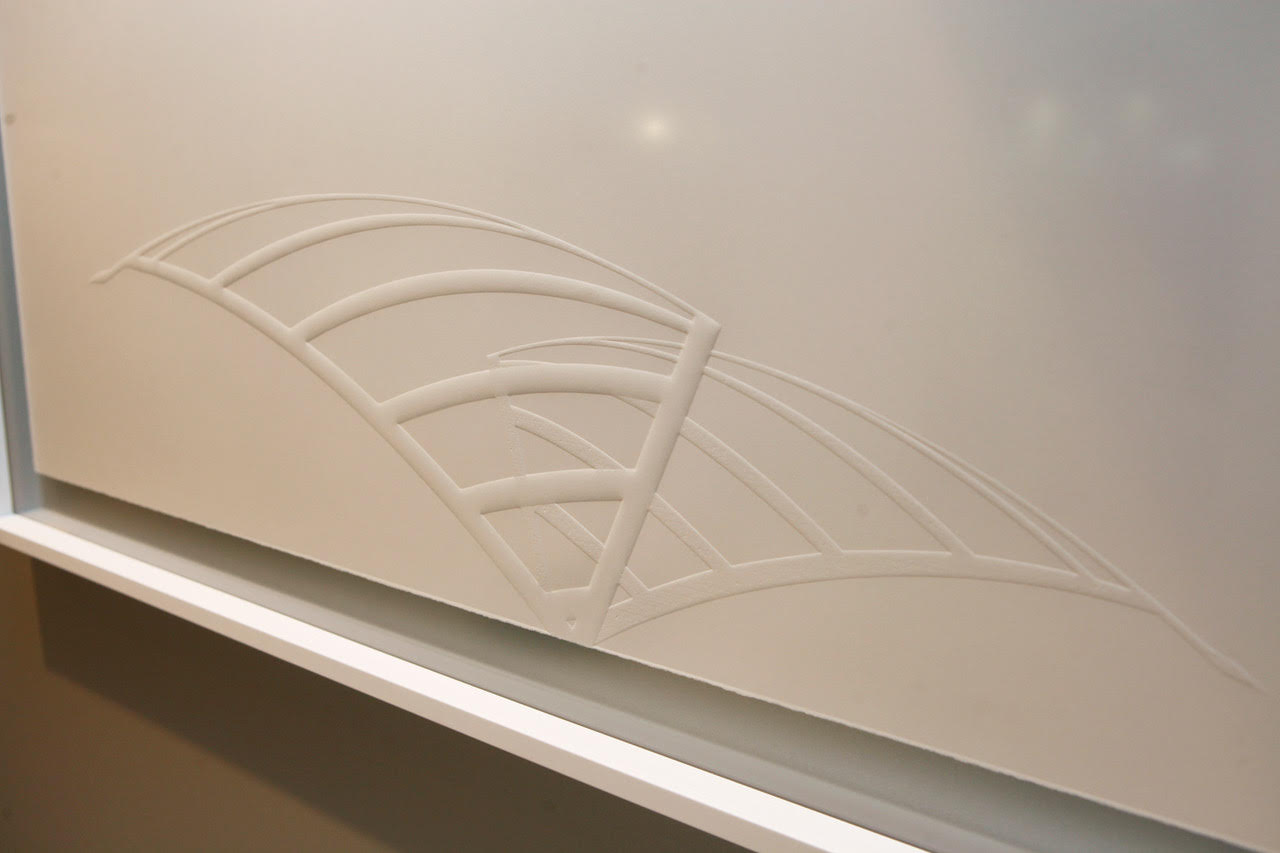
Marina evokes discomfort. Here, sharp lines forged in metal become semi-flat through
graphic press embossing. They are clean, colorless, deprived of any other dimension
but the void itself, where, after a brief moment, a viewer is able to see an image piecing
out of the surface (“void”), forged in sharp lines that evoke futuristic, almost art deco,
dynamic spatial solutions, thus standing opposite to, at first glance, Marina’s blank,
white paper, as if the image is not yet formed, thus the artist leaves only soft, barely
visible marks on a blank paper.
Again, Marina’s intention is not to disturb, but the colorless blank surface that creates
horror vacui brings discomfort. The viewer is looking for the wing that reaches out into
the blank space, yet this blank space provokes anxiety entrenched in our everyday
turmoil, challenges and demands of the world that we dwell in. Her Wing 3 evokes an
image of a human being firmly entrenched in this blank space; the massiveness of this
body is emphasized by the fragility of thin wingless arms and the dynamics of sharp
lines which stretch over the body leading the viewer’s eye out of the white surface. This
contrast between the massive motionless being and the vertical lines that like the
tightened ropes emerge from the blank surface only to ascend the body that appears
indifferent to its fate provokes discomfort in a viewer - as if this massiveness and
motionless has taken over of the being’s entire alienated existence. This being is not
one of the Giacometti’s fragile alienated men who wander through the space and time.
This antagonism between the massive and motionless being and tightened ropes
provoke the viewer to question her/his very own existence: Am I this massive
motionless being? Is this me?
Finally the work Wing 3, whether in its initial idea (sculpture) or in the media of graphic,
implies „emancipated viewer“ – the one who dares to face her/his discomfort, even
sadness, and to pose rather disturbing questions.
Dada Nikolić
Art Historian